
Emergency Garage Door Repair Near Me: What Cambridge Homeowners Should Do First
When a garage door won’t move, most people reach for the red release cord before they know what’s actually broken. That single move can be the difference between a spring repair and a full door replacement. A snapped torsion spring holds enough stored tension to injure anyone who tries to lift the door by hand, so the first job isn’t fixing anything – it’s figuring out what failed and whether the door is safe to leave where it is. Do that first, and the rest of the night gets a lot simpler.
If you’d rather have someone walk you through it, call (866) 254-2156. We answer 24/7. Fast dispatch from 7am to 7pm, Sunday through Friday.
Key Takeaways
- Never pull the red emergency release on a door with a broken spring – it can drop without warning.
- Decide whether the door should stay closed, stay partway up, or be secured before you touch anything.
- The opener motor failing is a different situation from a spring failing, and the release cord behaves differently in each case.
- When you call, have the door’s brand, spring type, and panel count ready so the right parts come with the technician.
- Garage doors are all we do, and that focus matters most when the call comes in late.
Is It Safe to Leave the Door Closed, or Does It Need to Be Secured?
If the door is fully closed and staying put, leave it closed. That’s the safest default in almost every case. A closed door keeps the garage – and everything connected to it – sealed while you wait. The real question is whether it’s actually closed, or just resting in a position that looks closed.
Walk the perimeter and check three things:
- Is the door sitting evenly on the ground? A door that’s crooked or resting on one side is under uneven tension and shouldn’t be forced.
- Is there a visible gap? A gap of an inch or more at the bottom or along one side means the door has dropped or shifted and needs to be secured.
- Can you hear or feel tension? If a cable is slack, frayed, or hanging loose, stop. That’s a sign the door’s counterbalance system has failed.
Cambridge winters change this calculation. On a cold night, a door that’s been left partway open is a real problem – pipes in an attached garage, a car you can’t move, and a house that’s suddenly open to the street. We’ve seen plenty of Cambridge homes where the garage connects directly to a kitchen or a hallway, and a partially open door there isn’t just a car problem. If the door can’t be brought fully down, securing it – even temporarily – matters more than getting it working.
If the door is stuck partway up and won’t budge, don’t fight it by hand. A door in that position is holding weight it can’t support, and moving it the wrong way can bring it down hard.
Should You Pull the Red Emergency Release Cord?
Not unless you know why the door failed. The red cord disconnects the door from the opener. It’s a useful feature when the opener is the problem and the door itself is fine. It’s a dangerous move when a spring or cable has failed, because the door’s weight is no longer being held by anything except the opener – and once you disconnect it, nothing is.
Here’s the difference in plain terms:
- Opener motor failure: The door feels heavy but balanced. You can lift it a few inches by hand and it stays. The motor runs but the door doesn’t move. Pulling the release here is usually safe – the door’s springs are still doing their job.
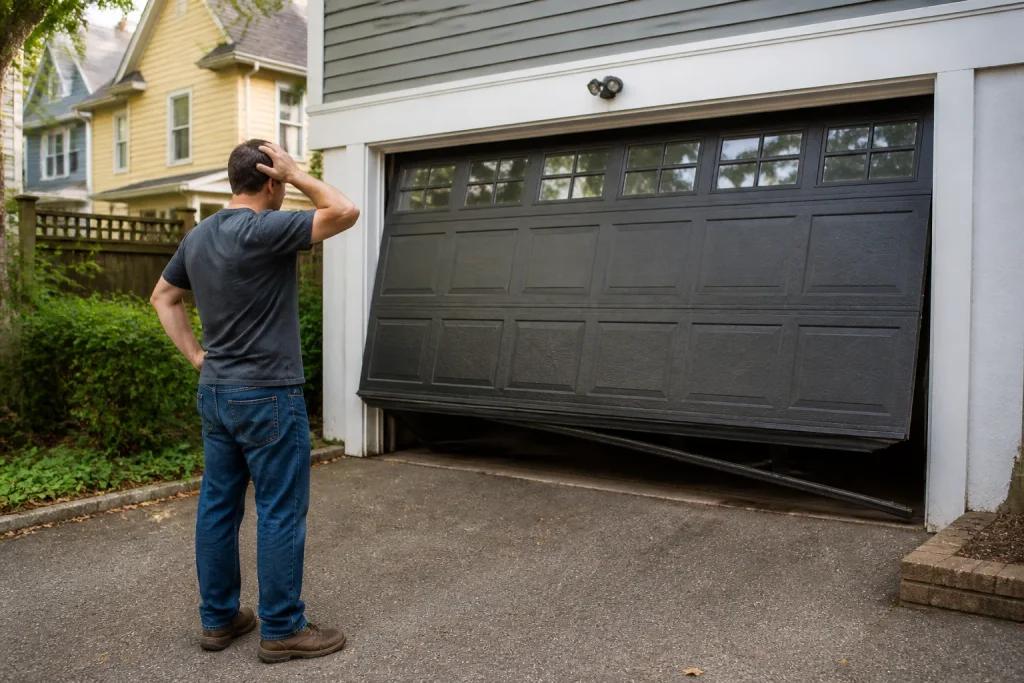
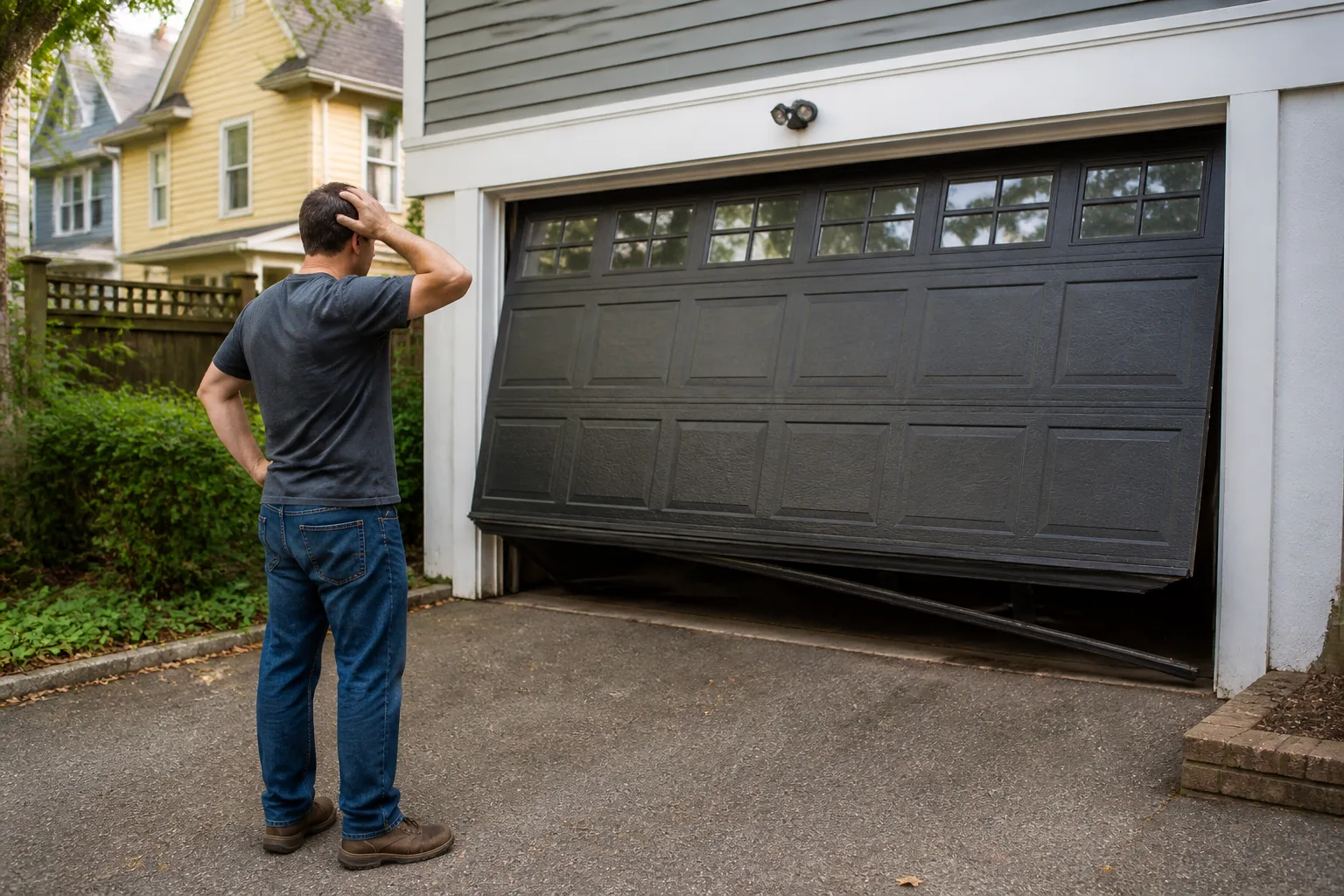
- Spring or cable failure: The door feels extremely heavy, or one side drops. You may hear a loud bang from the garage. The door sits crooked. Pulling the release here can send the door crashing down. Don’t.
If you’re not sure which one you’re looking at, assume it’s the spring. A technician can tell the difference in under a minute. When your garage door spring repair turns out to be the issue, that’s a job for someone who handles torsion and extension springs every day – not a generalist.
One thing worth saying plainly: if you’re hearing a bang, seeing a bent door, or smelling something burning from the opener, leave the whole system alone and call. We’d rather talk you through the safe options than have you risk an injury in a cold garage.
What Should You Tell the Repair Company on the Phone?
The more specific you are on the call, the fewer trips it takes. A technician who knows the door’s brand and spring type before arriving can bring the right parts instead of guessing.
Have these ready when you dial:
- The door brand. Clopay and Amarr are common on Cambridge homes; knowing which one you have helps us match panel and spring sizing.
- The opener brand, if the opener is involved. LiftMaster and Chamberlain are the most frequently installed in this area, and the diagnostic steps differ by brand.
- Spring type. Torsion springs run across the top of the door; extension springs run along the sides. If you’re not sure, describe what you see.
- Panel count and door material. A four-panel steel door and a five-panel wood door need different parts.
- What happened. Loud bang? Grinding noise? Door went up and won’t come down? The sequence tells us a lot.
A specialist asks these questions because the answers determine what goes on the van. A generalist often skips them and shows up to look, which is one more trip and one more night without a working door. That’s the practical difference between a garage door company and a handyman who’s willing to try.
Why Calling a General Handyman at 10pm Is a Liability
A handyman can replace a hinge or adjust a track. Garage door springs are a different category of work. They store enough energy to break bones, and the tools and technique for winding and releasing them aren’t part of general handyman training. When someone without that background takes on a torsion spring at night, the risks are real: a door that comes down unexpectedly, a spring that releases under load, an injury in a dark garage.
There’s a second problem, and it’s quieter. A generalist guesses. They may replace a spring with the wrong gauge, adjust a track to compensate for a problem that isn’t in the track, or reconnect an opener that was never the issue. The door works for a while, then fails again – and now you’ve paid twice.
What specialist dispatch looks like is different. The call is triaged before anyone drives out. The technician arrives with the brand knowledge and the parts for the likely failure. Springs, openers, panels – diagnosed and repaired by specialists, not attempted by whoever was available. Our technicians have up to 11 years of experience, and that experience is concentrated on garage doors rather than split across plumbing, HVAC, and everything else.
Temporary Security for Cambridge Row Houses and Attached Garages
In a Cambridge row house, an open garage door doesn’t just expose a car. It exposes the mudroom door, the hallway beyond it, and whatever’s stored along the garage wall. On a street where houses sit close together, a garage left open overnight is visible from the sidewalk in a way a suburban driveway usually isn’t.
If the door can’t be closed, these are the practical steps:
- Secure the interior door first. Lock or deadbolt the door between the garage and the house. That’s the boundary that matters most.
- Block the opening. A heavy object placed inside the door’s path, or a board braced across the opening from the inside, discourages casual entry. It won’t stop a determined person, but it buys time.
- Move what you can. If tools or valuables sit near the open side, shift them into the house.
- Leave a light on. A lit garage is less appealing than a dark one.
None of that is a substitute for a working door, but it’s what you can do between the call and the technician’s arrival. For a door that’s off its tracks or hanging crooked, don’t try to prop it – call and let a specialist secure it. That’s what garage door repair is for, and it’s the call that prevents a bigger problem.
When to Call a Pro
Call a professional any time the door won’t open or close evenly, whenever you hear a bang from the garage, and any time you can see a slack or broken cable. Don’t wait for morning if the door is stuck open on a cold Cambridge night, and don’t try to lift a heavy door by hand to test it. If the opener is the only thing that’s failed and the door itself is balanced, that’s a different call – and often a simpler fix. Our garage door opener repair team handles LiftMaster, Chamberlain, Genie, and the other major brands, so the right part is on hand.
Related services in Cambridge: Cambridge Garage Door Repair Pros handles spring repair, opener repair, and full installation across the door and opener system.
The Bottom Line
When a garage door fails, the right order is: figure out what broke, decide whether the door is safe where it is, secure what needs securing, then call. Don’t pull the red release until you know whether the springs are intact. Have the door brand and spring type ready so the technician arrives prepared. And skip the generalist on a cold night – the wrong hands on a loaded spring cost more than the right call.
If you’re in Cambridge and need help, Cambridge Garage Door Repair Pros offers free estimates – call (866) 254-2156. We answer 24/7. Fast dispatch from 7am to 7pm, Sunday through Friday.
Frequently Asked Questions
Yes, if the door’s springs are intact and the door is balanced. Pull the red release cord, then lift the door slowly – a balanced door should rise with moderate effort and stay where you leave it. If the door feels extremely heavy or slams down, stop and call. Call (866) 254-2156 for an exact quote – estimates are free.
A broken torsion spring usually makes a loud bang, and the door becomes too heavy to lift by hand. You may also see a visible gap in the spring coil above the door. Extension springs along the sides show a stretched or snapped coil. Don’t try to operate the door once you suspect a spring failure. Call (866) 254-2156 – estimates are free.
It’s not ideal. In a row house or attached garage, an open door exposes the interior door and whatever’s stored inside. Lock the interior door, brace the opening from inside, and leave a light on until a technician can secure the door. Call (866) 254-2156 to book a visit.
No. The written estimate sets the price before any work begins, based on what the technician finds during the assessment. If the scope changes because a second problem turns up, you’ll hear about it before anything is done. Call (866) 254-2156 – the estimate is free.
Written by the team at Cambridge Garage Door Repair Pros.
Need Garage Door Help?
Call Cambridge Garage Door Repair Pros - the local pro we connect you with is licensed and insured, here with fast help in Cambridge.
(866) 254-2156